When Time Doesn't Feel Real: ADHD, Time Blindness and the Eisenhower Matrix
I say this a lot in workshops and coaching, and I mean it: I don't believe in productivity hacks. If one works for you, brilliant. But what actually lasts isn't a hack. It's a change in how you see yourself.
When Time Doesn't Feel Real: ADHD, Time Blindness and the Eisenhower Matrix
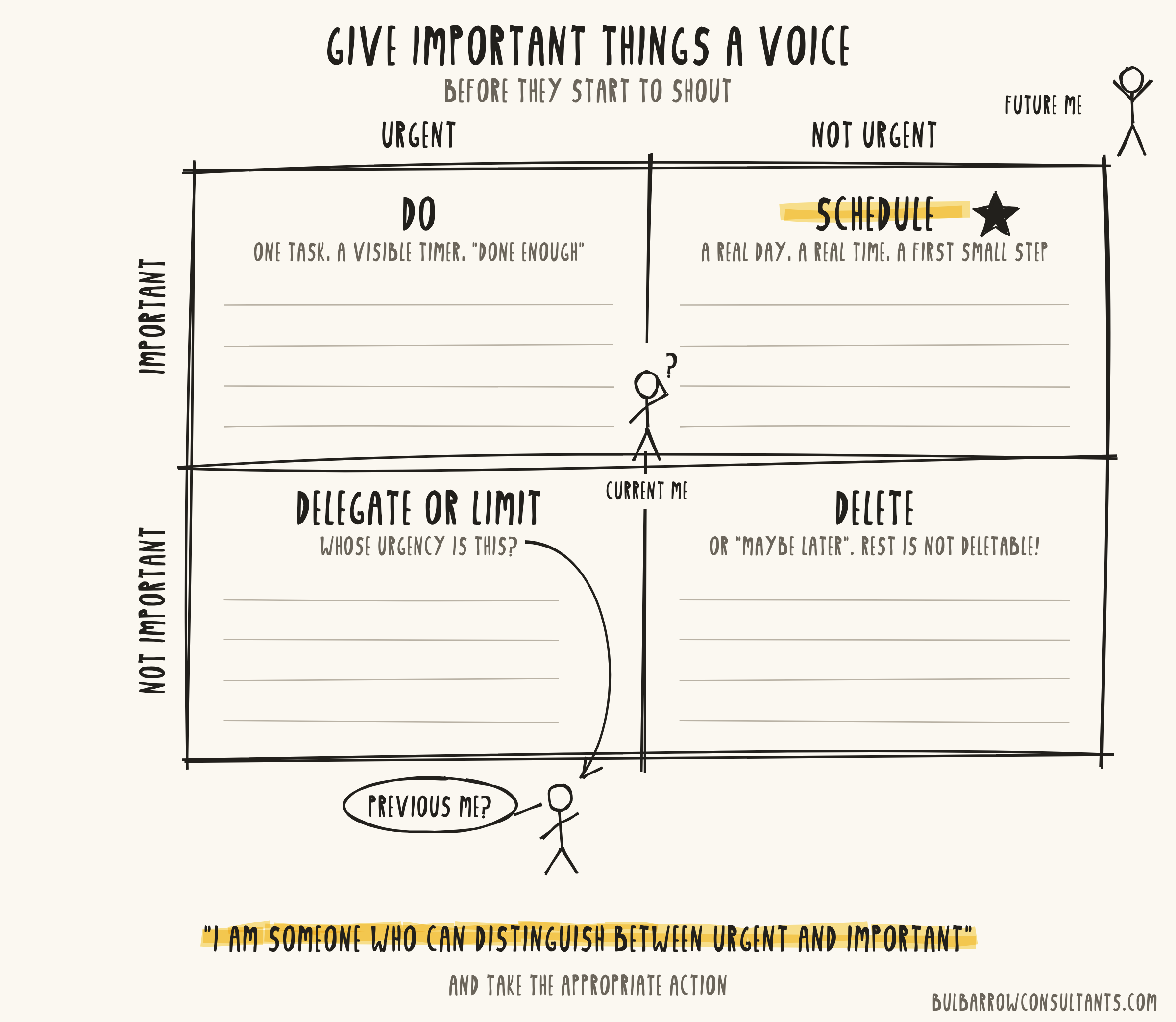
I say this in workshops all the time. I don't believe in productivity hacks. If one works for someone, great, I'd never stop anyone using one or teaching one. But what actually lasts, in my experience, isn't a hack. It's a change in how we see ourselves. How we carry ourselves through the day.
Which makes it weird that I'm about to spend a whole blog on the Eisenhower Matrix. Classic productivity tool. As standard as they come.
But here's why I think it matters. It doesn't work as a hack. At least not for an ADHD brain. Where it becomes useful is as a way of practising a different identity:
> I am someone who can distinguish between urgent and important, and take the appropriate action.
To get there we need to understand why time is so slippery in the first place.
Most time management advice assumes the problem is organisation. Better diary, more alarms, try harder. For a lot of us with ADHD the difficulty starts a step earlier. It lies in sensing time at all. Feeling it pass. Connecting what we're doing now to something that will happen later.
That's what usually gets called time blindness. It can mean underestimating how long something will take. Not noticing an afternoon disappear. Struggling to start anything whose deadline feels far away. Getting so absorbed in one thing that everything else stops existing.
It isn't a formal diagnosis. It doesn't show up the same way in everyone with ADHD. But it does overlap with difficulties that are well recognised. The US National Institute of Mental Health lists poor time management, planning and organisation among the things adults with ADHD may struggle with.
It isn't just a metaphor either. Studies have found real differences in how people with ADHD perceive time, although it varies a lot from person to person.
What the research does back up is something I see in casework all the time. We can understand time perfectly well in our heads and still not be able to use it reliably in the moment.
When "later" suddenly becomes "now"
Time blindness tends to split the week into two very unequal places. Not now and now.
A report due next Friday sits somewhere off in the distance for days. We know it matters. But it doesn't press on us. Then on Thursday evening it suddenly becomes real. Anxiety, adrenaline, the sheer novelty of the panic give us enough fuel to start. We work through the night.
From the outside that looks like carelessness. Or like someone who enjoys leaving things to the last minute. From the inside?
It feels more as though the task didn't properly exist until the deadline was close enough to touch.
Repeat that often enough and it becomes a loop. An important task feels a long way off. Starting it means planning, holding things in working memory, generating our own motivation from nothing. Whatever is more immediate wins the fight for attention. The deadline arrives, turns into a crisis. The crisis finally supplies enough urgency to get us moving. We get it done under pressure. Which teaches our system that urgency is how things get done.
The standard reading is that the person doesn't grasp what's important. That's rarely what's going on. They usually know full well that it matters.
The real difficulty? Getting importance to exert any pull before it turns into urgency.
For an interest-based nervous system, urgency is one of the few things that reliably switches the engine on. Crisis works, so crisis becomes the strategy. And it costs a great deal every time it's used.
The promise and the problem of the Eisenhower Matrix
The Eisenhower Matrix sorts tasks using two questions. Is this important? Is this urgent?
The distinction between urgent and important is often linked to a 1954 speech by US President Dwight Eisenhower, in which he quoted a former college president drawing that same line. The familiar four-box productivity tool that bears his name developed later, built on that underlying idea by others in the management and productivity field. Eisenhower didn't design the matrix itself.
It usually looks like this:
| | Urgent | Not urgent | |---|---|---| | Important | Do | Schedule | | Not important | Delegate or limit | Delete |
On paper it should suit ADHD well. Because it separates what actually matters from the emotional heat of a looming deadline.
In practice?
The standard version quietly assumes that we can judge future urgency accurately. Keep long-term goals in mind. Break vague projects down into actions. Resist whatever feels most stimulating right now. Remember to come back to the work we scheduled.
Those are exactly the things ADHD makes unreliable. So the matrix can describe the problem very well without doing much to solve it. A neatly filled "important but not urgent" box is no use to anyone if what's in it stays invisible until it becomes an emergency.
Making the matrix work with the wiring we've got
The answer isn't to throw the matrix out. It's to make time and priority concrete enough that we can actually see them.
Urgent and important: Pick one task. Work out the next physical action. Start with a visible timer. Decide what "finished enough" looks like before beginning.
Important but not urgent: Put the first work session in the calendar straight away. Give ourselves an earlier personal deadline. At least one external reminder.
Urgent but less important: Delegate it, automate it, say no, or give it a strict time limit. Ask whether the urgency is really ours or somebody else's.
Neither urgent nor important: Delete it or move it to a separate "maybe later" list. Don't confuse rest with unimportant activity. Because rest may be exactly what keeps the rest of the system running.
The quadrant that matters most is usually important but not urgent. It's where exercise, money admin, relationships, preparation and long-term projects tend to live. Also where time blindness does the most damage. Because these are the easiest things to put off while the consequences still feel abstract.
That's why "schedule" has to mean more than picking a day.
A useful calendar entry isn't "Work on presentation next week." It's "Tuesday, 10:00 to 10:25: open the presentation, write the three section headings and draft the first slide."
The second version takes time out of our heads. Puts it somewhere we can see it. It removes the guesswork, gives us a clear starting cue. Turns a vague project into something we can actually do.
A five-minute version
A full four-box exercise can easily become one more thing to avoid. A lighter routine is usually more sustainable.
Write down no more than five live tasks. Mark each one for importance and urgency. Choose one urgent and important action for today. Schedule one important but not urgent action for a specific time. Remove, limit or delegate one lower-value demand.
Then set a reminder to do it again.
The review is the bit that makes it work. Because a matrix is only a snapshot. Priorities and deadlines keep moving even while our attention is elsewhere.
When sorting things feels hard, four questions can help.
Consequence: what's likely to happen if this waits seven days?
Ownership: is this really my responsibility?
Action: what's the next visible thing I can do?
Time: exactly when will I start it?
Building the evidence
For a lot of us with ADHD, being "someone who can distinguish between urgent and important" won't feel true at first. Years of Thursday-night panics. Missed deadlines. Being called disorganised. That leaves a story behind. And that story usually says the opposite.
Simply telling ourselves the new version won't make it stick.
But evidence will.
Every time we put one important task in the calendar and then actually open the file at ten o'clock on Tuesday? We give that sentence a little more to stand on. The matrix is just the place where that practice happens. Over time the belief and the behaviour start to hold each other up.
Go deeper: whose urgency is it?
Earlier I suggested asking whether the urgency is really ours or somebody else's. If we want to take that question further, it's worth turning it inward as well. Because sometimes the "somebody else" is an earlier version of ourselves.
In psychosynthesis, the approach I trained in, we talk about subpersonalities. The different parts of us that formed at different points in our lives. Usually to meet a particular need or to keep us safe. Each of them carries its own sense of what matters and what can't wait.
So when something feels urgent or important? It's worth pausing to ask who it's urgent or important to.
Is it urgent to me, now, as I am today? Or am I letting a previous version of myself decide what I act on and what I leave alone?
That earlier version might be the person who learned that the only way to be taken seriously was to answer everything immediately. Or the one who was called lazy so often that any unanswered demand still feels like proof. Those parts made sense at the time. In their own way they were trying to look after us.
It's still fair to ask whether something that was urgent to us ten years ago is appropriate for the person we are now.
There's a second question hiding in here. And it points the other way.
If an earlier version of me can set my priorities, then the version of me a week or a month from now is the one who pays for whatever I leave undone.
Seen that way? The important but not urgent box is really a list of things future me is going to need. Scheduling one of them is a way of looking after that person.
So it's worth asking which of these is most likely to slide from important into urgent, and from urgent into a crisis, if I leave it alone. Then ask what the smallest thing is that I could do today so future me never has to deal with the crisis version.
In psychosynthesis we call this disidentification. Which simply means noticing the part of us that's doing the pushing, rather than being run by it. Once we can see it, the choice comes back to us, now.
Using it without beating ourselves up
If our urgent and important box is always overflowing, please don't take that as proof of being lazy or useless. More often it means there's too much on the plate. Too little support around us. Or a planning system that only shows us the future once it's already on top of us.
That said. Understanding why it happens doesn't make the pattern go away.
It's still ours to work with. Knowing how the mechanism works gives us somewhere to start.
The matrix isn't a treatment for ADHD, and it doesn't need to be. Its value lies in the ideas it puts into practice. Getting information out of our heads. Practising planning and organisation. Building concrete time-management skills. There's good research that points to all of this.
I think of it as a bit of scaffolding. It won't give us a reliable sense of time. But it gets our deadlines, priorities and their consequences down on paper. Where we can see them and do something about them.
And if the future tends to stay quiet until it's shouting at us? The trick is to give the important things a voice early enough that we can hear them.